![]() |
![]() Rosarios Grandmother * |
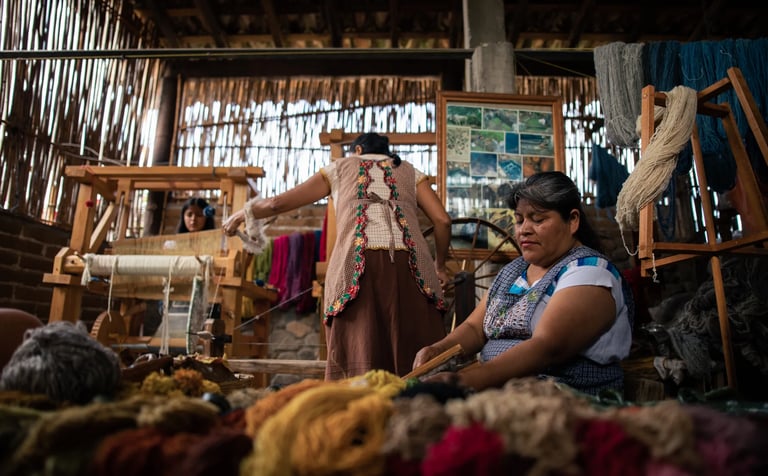
Teotitlan del Valle is a village in the valley of Oaxaca that dates back to a time when the Zapotecs first settled in Oaxaca, around 1000 B.C. The Zapotecs developed a highly diversified culture, with complicated systems of writing and counting, elaborate architecture and a dynamic theory of astronomy. As a mainly agrarian society, citizens wove fabric for their own use, and for the Mixtec and Aztec groups who came to the valley later. Archeological evidence suggests the use of cotton and maguey cactus fibers, as well as a primitive weaving device, the backstrap tension loom. |
|
![]() Four Generations |
In
the early 1500s, weaving processes in Teotitlan changed radically with
the introduction of the upright pedal loom by Dominican friars who accompanied
the Spanish conquistadors in their colonization of Mexico.
Using
wool from churra sheep that were also introduced by the conquerors, weavers
created blankets with simple designs that by the early 1900s had become
exquisitely detailed patterns. These stellar pieces along with less complicated
versions, were traded at markets for staples such as maize, beans, weaving
materials, and dyes. |
|
![]() Rosarios Mother Spinning |
With
the Mexican Revolution in 1910 and its rejection of foreign economic control
and cultural influence, there came a surge of ethnic pride including a
glorification of Mexico's pre-Colombian traditions. Traditional foods,
clothing, music, and crafts took on the status of national treasures.
The Zapotecs of Teotitlan capitalized on their new found acclaim by resurrecting
and incorporating into their weavings ancestral designs like the caracol
geometric found carved in the walls of local ancient ruins.
By
the 1970s, the village weavers expanded their production from blankets
to tapestries and ultimately to rugs. |
|
![]() Rosario with her Mother |
Weaving
in Teotitlan de Valle is intimately tied to the family unit, where everyone
participates in the production process. Women card and spin the wool by
hand into the fine diameter yarn, while traditionally, men do the weaving.
Children learn the intricate processes under their tutelage of their parents
and grandparents, who create the designs and dyes for the unique look
that distinguishes a particular family’s work.
Among
the premier weavers of Teotitlan you will find my grandfather, Isaac Vasquez
who, in collaboration with the famous Oaxacan painters Francisco Toledo
and Rufino Tamayo, brought back the old techniques of extracting dyes
from natural materials. The intense reds, subtle pinks and purples obtained
from cochineal and the range of blues from the indigo plant contributed
to Isaac Vasquez’ artistic legacy in Teotitlan, and transformed
his weavings into works of art. |
|
![]() Rosarios Father, Antonio Martinez while in Colorado |
My
father, Antonio Martinez, is another master weaver in Teotitlan. With
his wife Estela (daughter of Isaac Vasquez), Antonio revived the antique
designs of México, rendering them in a range of brilliant colors
that he and Estela created.
|
|
![]() Rosario Martinez Vasquez Age 16 |
The
Martinez Vasquez family, including Antonio and Estela, their two sons
Antonio and Juan, two daughters-in-law, and me, Rosario, with my husband
Ernesto, is one of a handful of families weaving in the tradition of our
ancestors. |
|
![]() Ernesto, Rosario, Kim and Carol |
All
of our wool is hand spun and colored with dyes produced from fruits, nuts,
plants, and insects that have been gathered in the surrounding countryside.
Many of these materials are seasonal and are stockpiled to be used throughout
the year. The weaving process in itself will take anywhere between 3-5
weeks on the loom depending on the size and complexity of the design. |
|
![]() Ernesto and Rosario |
Today,
our weavings receive international recognition for their quality, beauty,
and the use of natural materials. We have preserved our ancient traditions,
and our work is truly a representation of who we are. |
Email: eltonodelacochinilla@gmail.com
*Photo by Clare Brett Smith
| © El Tono de La Cochinilla 2007 | Designed
by William Frederick |